Comhampton
Solar Farm
A proposed ground-mounted solar development generating clean renewable energy for thousands of homes and businesses across the local community.

About Us
Tyler Hill Consulting &
Zenexa Renewables
Tyler Hill Consulting is a renewable energy developer who specialises in end-to-end development of onshore renewable energy assets across the United Kingdom from project origination through to Ready to Build (RTB).
Tyler Hill Consulting will develop, build and operate a pipeline of 5GW of onshore renewable energy assets. Zenexa Renewables has been set up to own these assets long term with the goal of becoming a leading Independent Power Producer (IPP) platform to support the UK's transition towards net zero.
Tyler Hill Consulting is now part of the Zenexa group.
–
Our pipeline at a glance
The Proposal
The Scheme & Project Benefits
The proposed Comhampton Solar Farm is a carefully designed renewable energy development in Worcestershire, built to power local homes while protecting the countryside for future generations.
The Scheme
The proposed Comhampton Solar Farm comprises ground-mounted solar panels, cable routing, ancillary infrastructure and a substation which connects to the Distribution Network Operator (DNO).
The Scheme has been designed to operate for up to 40 years, after which it will be fully decommissioned and the land returned to its agricultural use.
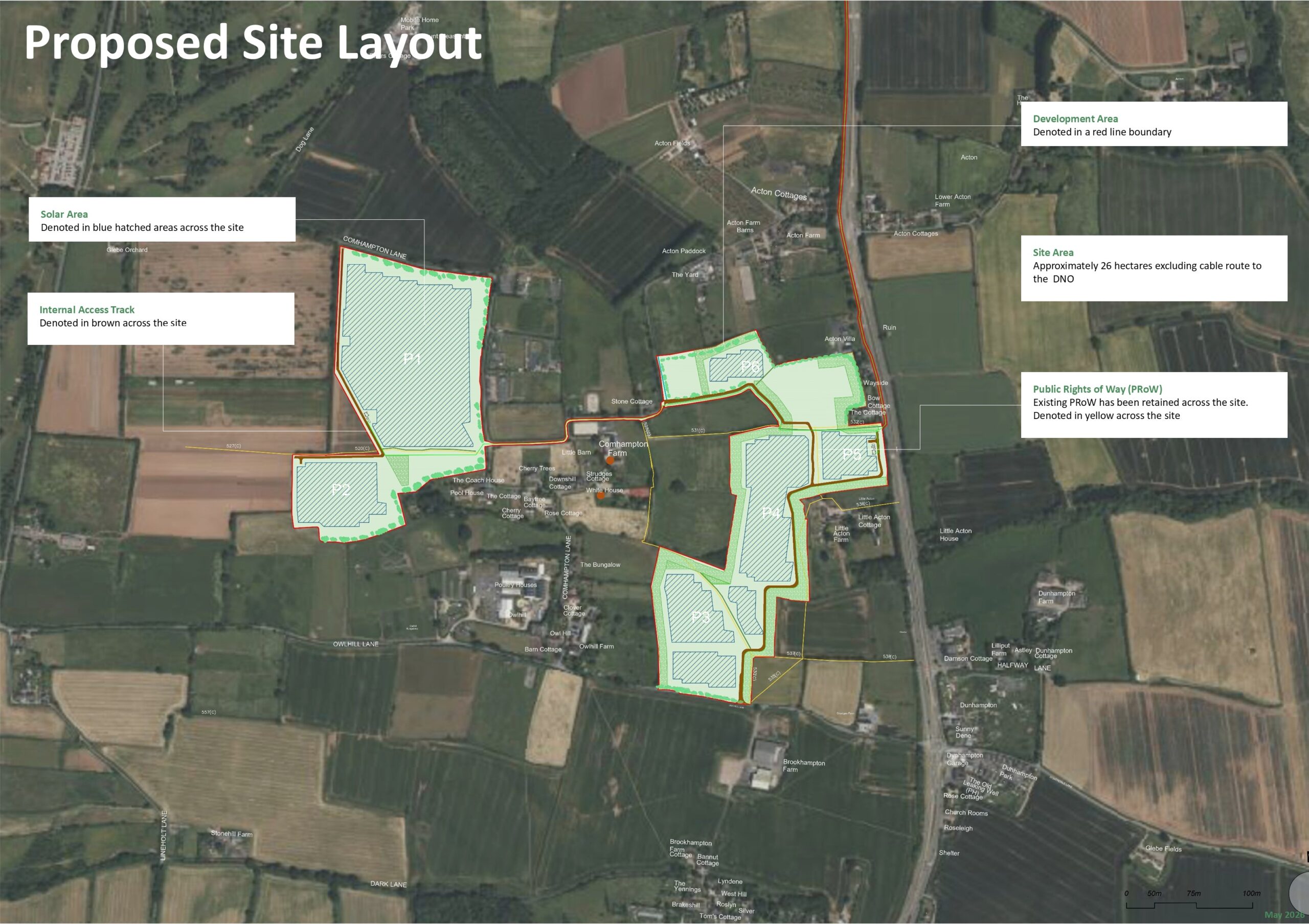
The current layout plan is as follows:
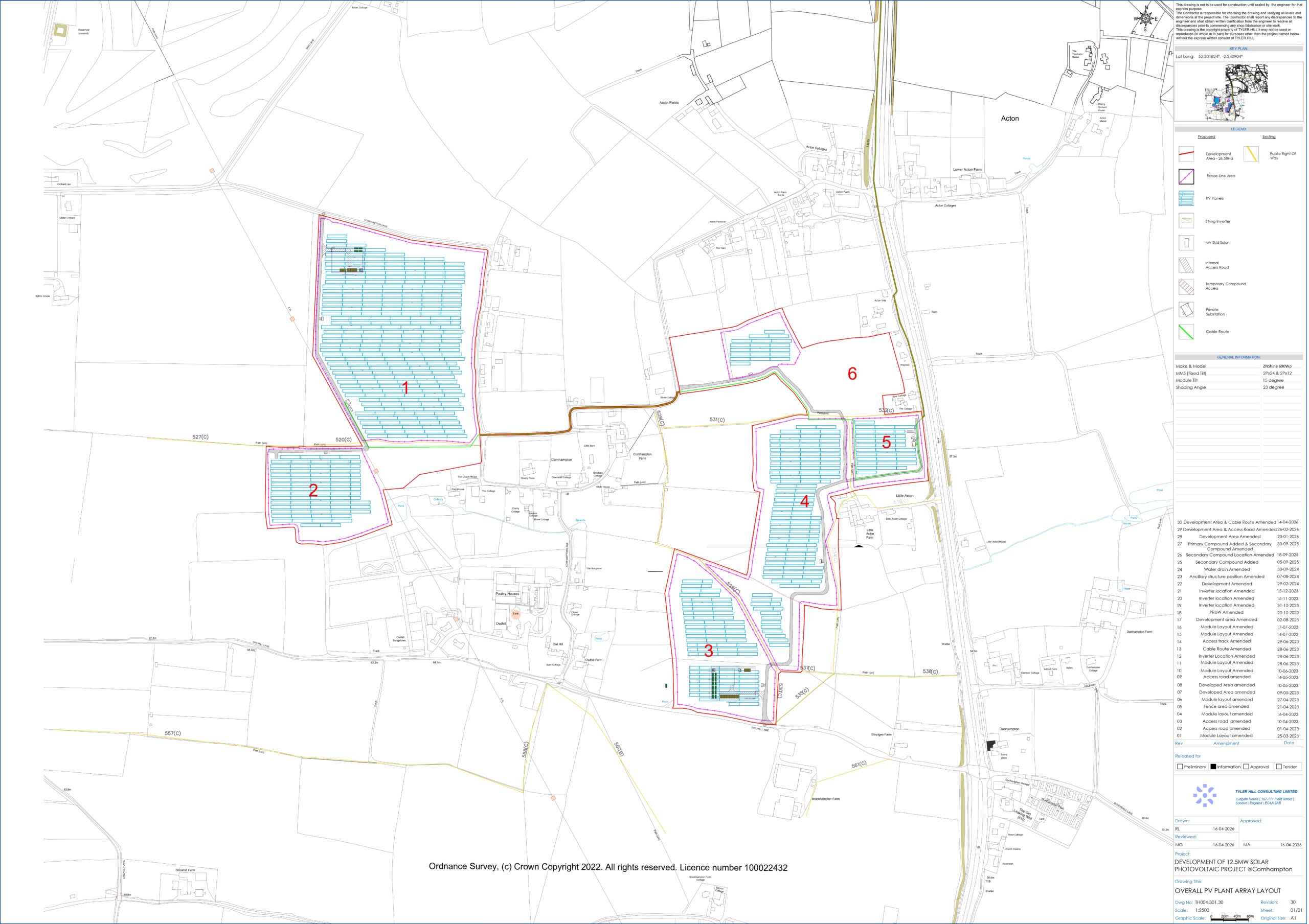
Current Technical Layout Plan
This is the current technical drawing which can be read alongside the above illustrative drawing.
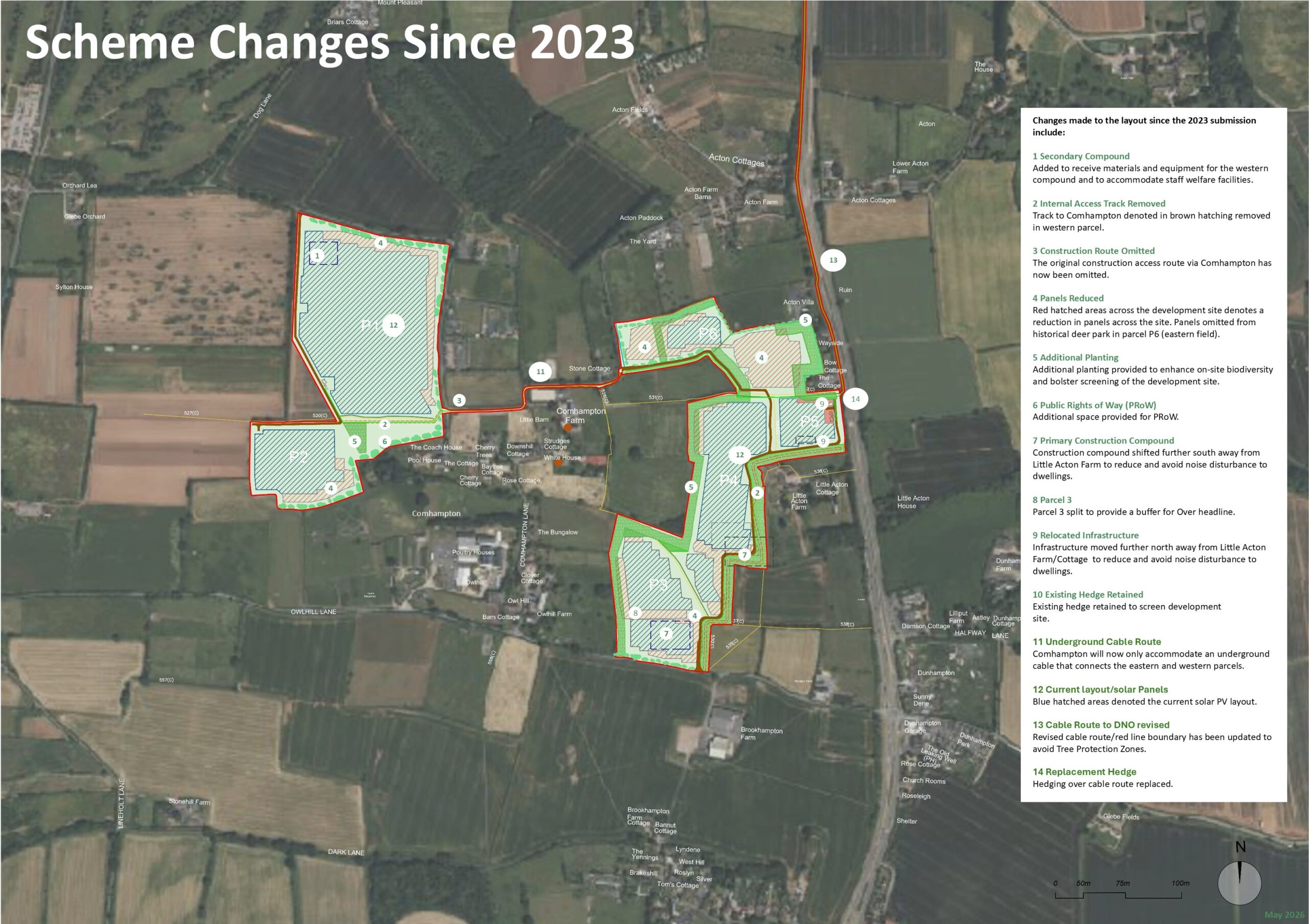
Scheme Changes since 2023
Since the initial submission in September 2023, Tyler Hill Consulting has been reviewing and refining Comhampton Solar Farm based on your initial feedback on the project. The following illustration below captures the changes and updates made to the project since 2023.
Project Benefits
Community Benefit Fund (CBF)
We are proposing a Community Benefit Fund, which is a voluntary commitment made by us to financially support community initiatives that fosters growth, sustainability and resilience with your community over the 40 year lifetime of the project.
Supporting the UK's goal of net-zero carbon
The project will contribute to the UK government's target of reaching a net-zero carbon electricity grid by 2035 and an overall net-zero carbon economy by 2050.
Local impact
Our proposal to generate more renewable power in UK will support the council's priorities around tackling climate change and generate more electricity from renewable sources.
Continued Agricultural Use
The site has been designed to enable continued agriculture in the form of sheep grazing, while also retaining the public footpaths through both the eastern and western parcels of the site.
New Planting
Comhampton Solar Farm has been designed to enhance on site biodiversity through the planting of new trees and hedgerows while retaining existing vegetation around the periphery of the development site much as is reasonably possible and where effected, it will be replaced.
Consultation
Have Your Say
Your input is important in helping to shape and develop this project. We want to ensure the proposal reflects the needs and values of your local community.
2026 Community Event
Thank you for attending the community event on 5 May 2026 at Hartlebury Parish Hall. Due to a website error the consultation period for all online responses has been extended to 26 May 2026 midnight.
Below is the list of the consultation material that was presented at the community event.
Following the end of the consultation period, your feedback and comments will be reviewed and taken into consideration of the final scheme.
The Timeline
Project Milestones
FAQs
Frequently Asked
Questions
Why did you select this site?
As with all solar farm projects, the Comhampton Solar farm project has undergone a rigorous and iterative site selection process to identify suitable locations which are acceptable both in terms of planning considerations and energy generation. This required consideration of alternative sites, planning policy and integration with the Grid Networ, including an agreement with the relevant Distribution Network Operator (DNO).
The following summary provides an overview of the method we utilised to find suitable land within the area:
- At the outset we looked at regional factors such as good levels of irradiation, large areas of open flat land. Alongside this, we considered key high level planning and environmental constraints such as internationally designated sites, sites of landscape importance etc.
- Concurrently we looked at grid capacity, it is important to bear in mind that not all parts of the electricity network in England are suitable for new connections which limits the areas to which a suitable connection can be made. Once capacity had been identified on the 132 kilovolt (kV) circuit, a Point of Connection (POC) was established at a location along this circuit, which would connect back to Bishop’s Wood Substation, agreed with the DNO.
- We then began a more detailed site selection by establishing a study area within a radius of 1.8km from the POC based on the viability and other considerations of the project. The study area has to be within a feasible distance to the POC.
- Within this radius/study area, we began to look at environmental, planning and other constraints in more detail, while also looking at Brownfield land, smaller sites, feasible rooftop search etc. A number of constraints were identified which further narrowed down available sites, including an area of Green Belt located to the north and east of the POC, restricting any development within this area.
- Landowners were also approached at this point and not all suitable land identified had willing land owners which limited land availability for development, equally not all land identified was considered developable due to constraints that we would not be able to mitigate.
- The site taken forward for development at Comhampton is of a suitable size to accommodate a viable project, it avoids key environmentally designated areas and is considered to be able to overcome and mitigate any likely impacts generated by the project. Crucially the site also has willing landowners and is available for development now which is why the site was taken forward for development.
The selected site is suitable in scale, avoids key constraints, has willing landowners, and is deliverable.
Will the development impact on agricultural land?
We understand your concerns around this but we do not consider that the development will impact on agricultural land. Solar does not take agricultural land, rather it borrows it, and in the case of Comhampton Solar Farm, it will temporarily occupy a small area of land which will be returned and reinstated to farming land after the project has been decommissioned.
Following a rigorous and iterative site selection process, the development site was carefully selected to ensure it considered a range of national and local matters including, net zero targets, projects benefits and accordance with planning and environmental considerations and energy generation.
Though the development site is located on Best and Most Versatile (BMV) Agricultural Land with 80% of the land classified as Grade 1 and around 20% classified as Grade 2, it considered that the benefits of the project outweigh any temporary impacts and several studies have been submitted with the planning application to demonstrate the need for the location of development on higher grade soil.
Further, Defra’s DEFRA Strategy paper (2026) projects that by 2030 solar and wind will remain a very small proportion of land use even though the government is targeting an energy system to be powered largely by renewables (95%).
The current statistics help to put this into perspective:
- 69% of UK land area is farmland.
- 2% of total UK land area (270,000 hectares) is given over to golf courses.
- In contrast, only 0.1% is currently occupied by solar farms, which is only 1/20th of the area for golf courses.
- This 0.1% of land provides 20GW of the UK’s power supply (around 30% of the country’s total power needs on cool sunny spring days).
- If the UK is to achieve its 2050 Net Zero targets, we will need to increase solar to 80GW.
- The land area to accommodate 80 GW will also increase to 0.5% of all UK land. This will still be only be ¼ of that given over to golf courses. We of course as a society do need to prioritise recreational activities in the countryside - we are not averse to a healthy and enjoyable round of golf but this paints a picture of how land is currently used in the UK!
With the recent war in the Middle East, it highlights how very important it is for the UK to move away from gas and oil and toward renewable generation. This will help to mitigate future price shocks and Comhampton Solar will project will help the UK to achieve this strategic goal.
The studies and reports submitted with the planning application include ‘Site Search Assessment (Submitted January 2025)’ and ‘Comhampton Solar Farm Use of Agricultural Land, July 2023’ amongst other evidence based documents that should be read alongside the summary below and can be found on Wychavon Council’s planning website under the reference W/23/01894/FUL.
In summary the studies convey that there were no alternative sites that were suitable within the search radius at the time of review and highlights inter alia, that the development:
- Is temporary and completely reversible at the end of its life resulting in no loss of agricultural land in line with the provisions of the NPPF and the National Policy Statement for Renewable Energy Infrastructure (EN-3).
- Will support farm diversification to help ensure the continued viability of the farm holding.
- Will be multifunctional. The land can simultaneously be used for sheep grazing, therefore the agricultural use can be partially retained.
- Will secure and generate affordable renewable energy to power 6,405 homes, thereby supporting the transition to a zero-carbon energy system.
- Will improve biodiversity through the planting of new trees, hedges, and buffers around the solar farm to deliver a significant increase in overall habitat compared to the existing site.
Accordingly, the benefits and lack of alternative sites demonstrates a strong and compelling planning case for temporarily using a relatively small amount of higher-grade land. Finally, it is important to note that solar development does not destroy farm land. It rests the soil and takes it out of intensive agricultural production. At the end of the solar farm’s life the land could be re-purposed once again primarily for farming.
Will the development impact on food production?
We understand your concerns around this but do not consider that the development will impact on food security. Solar Energy UK (2022) reports that claims that solar farms jeopardise the UK’s food security are false, on the contrary, the opposite is true. Further, there is no concern from Government about food security. There is enough land for renewables, housebuilding and food production to coexist in the UK, they “are not competing demands” (DEFRA Strategy paper).
Defra’s report projects that by 2030, although the government is targeting an energy system to be powered largely by renewables (95%), solar and wind will remain a very small proportion of land use.
The current statistics help to put this into perspective:
- 69% of UK land area is farmland.
- 2% of total UK land area (270,000 hectares) is given over to golf courses.
- In contrast, only 0.1% is currently occupied by solar farm, which is only 1/20th of the area for golf courses.
- This 0.1% of land provides 20GW of the UK’s power supply (around 30% of the country’s total power needs on cool sunny spring days).
- If the UK is to achieve its 2050 Net Zero targets, we will need to increase solar to 80GW.
- The land area to accommodate 80 GW will also increase to 0.5% of all UK land. This will still be only be ¼ of that given over to golf courses. We of course as a society do need to prioritise recreational activities in the countryside - we are not averse to a healthy and enjoyable round of golf but this paints a picture of how land is currently used in the UK!
With the recent war in the Middle East, it highlights how very important it is for the UK to move away from gas and oil and toward renewable generation. This will help to mitigate future price shocks and Comhampton Solar will project will help the UK to achieve this strategic goal.
It is important to note that Climate Change is the single biggest threat to the UK’s food security and solar can help to address this. According to DEFRA, climate change could reduce the UK’s stock of high-grade agricultural land by nearly three-quarters by 2050 but because solar farms generate near zero carbon electricity, they will help to tackle climate change thus improving the UK’s food security.
Further, solar energy helps to keep costs low, which helps UK farmers to stay in business for longer. Solar energy provides some of the cheapest electricity without which energy prices would be even higher. With the cost of living rising, agricultural businesses are increasingly facing financial difficulties but solar projects provide farmers with a direct and long-term revenue stream where they chose to host a project on their land. By helping to keep UK farming profitable, solar is also helping to secure the UK’s domestic food supply.
The applicant is also currently in discussions with the landowner who is a local shepherd in relation to ensuring food production via the grazing of sheep.
Planning permission for a solar farm is time limited, and installations are completely dismantled at the end of their operation. Solar does not take agricultural land, rather it borrows it, and because agricultural land under a solar farm is in effect left fallow, soil health can recover and the land can go back to farming.
Will there be sheep grazing on site?
Yes. The proposal seeks to combine renewable energy generation with sustainable land use practices by incorporating sheep grazing. The applicant is currently in discussions with the landowner who is a local shepherd and keen to graze sheep on Comhampton Solar Farm.
The final details including consideration of breed type to ensure suitability to soil conditions, rotational grazing system and the management mechanism for grazing is anticipated to be secured through planning conditions in a Grazing Management Plan (GMP).
There are various examples of sheep grazing on solar farms within the UK, including The Great North Road Solar and Biodiversity Park, which is set to be the largest UK solar farm to embrace grazing. When the development comes into operation in 2027, a flock of almost 4,000 sheep will graze the solar park’s fields, which could increase up to 9,000 once lambing begins.
Stanborough Solar farm received planning permission in 2024 from by Welwyn Hatfield Borough council to graze sheep with a GMP secured through planning conditions prior to construction.
Does the development pose a fire risk?
The development does not include a Battery Energy Storage Systems (BESS) which is generally associated with a greater fire safety risk.
The risk of solar panel systems catching fire is extremely low, however, there are certain measures we will undertake to mitigate and manage this risk:
- We will ensure that we source high quality components and panels as we are aware that the data shows that product defects make up a significant portion of solar-related fire, where poor quality or incompatible components add to the risk of fire.
- Inverters and other electrical equipment will incorporate built-in safety features such as overcurrent protection, fault detection, isolation mechanisms, and automatic shutdown in the event of abnormal operating conditions, thereby minimising fire risk.
- The site will be continuously monitored through a remote (virtual) monitoring system, enabling real-time fault detection and alerts. In the event of any abnormal conditions or fire-related incidents, alerts will be immediately raised, allowing for rapid response and coordination with emergency services.
- We are also proposing ground mounted solar and not roof mounted solar which has a high risk of catching fire due to often being incompatible with the roof itself.
Full details of how fire safety risk will be managed will be set out in a fire risk management plan to be secured through planning conditions and prior to construction. This will be consulted on with the local emergency services and will include details on:
- Photovoltaic system risk control measures
- A suitable fire risk assessment
- Details of installation of PV with a certified and competent professional
- Design and install PV systems in accordance with the relevant Code of Practice
- Maintenance of PV to ensure components are well maintained and not in a condition that could cause fires
Will the development affect property value?
We understand this concern and are not aware of any data or examples in the UK where solar farms have effected property values, therefore, we do not consider that the proposed development would impact on property values. Further, property values are not a material planning consideration in the decision making of a planning application.
Are there any mammal gaps in fences?
Yes there are. The locations of the small mammal gaps in the fence will be determined by an Ecologist based on up-to date survey data ahead of construction. This commitment will be secured through a Construction Environmental Management Plan (CEMP) which sets out a methodology for how a construction project will manage environmental risks, minimise ecological impact, and comply with regulations.
Mammal gaps will be incorporated into fencing to allow continued movement of small mammals, such as hedgehogs and brown hare to pass though.
Will the development affect deer?
Two areas within field 6, including the historical deer park and the area to the south east of field 1 would be open to deer movement as these areas are not fenced off.
Further, deer fencing is proposed to safeguard equipment and the deers from each other, within the development area.
Will the development include site security?
Yes, the development will include appropriate security measures, including fencing and surveillance, while minimising any impact on the surrounding environment:
- A 2m high post and wire mesh deer fence will be constructed around the development, with vehicle gates to allow vehicle and pedestrian access (there will be no public access to the development area). Appropriate safety signage will be displayed on the fencing and gates.
- Infrared and/or thermal imaging CCTV cameras will be installed along the site boundary to provide continuous security coverage. The cameras will be inward-facing, ensuring that monitoring is limited to the development area only, with no intrusion on public rights of way or neighbouring land.
- No permanent external lighting is proposed as part of the development, to minimise visual and ecological impact. Temporary lighting may be used during the construction phase where necessary. Any emergency lighting required for maintenance or safety purposes will be deployed on a temporary, as-needed basis only.
Contact Us
Get in Touch
If you would like to speak to us or share your views on the project, please get in touch using the details below or via our contact form.
Part of the Zenexa Renewables Group
Worcestershire · DY13 9TD
Send us a message
Success
Message sent successfully!